

Hiring the wrong SEO agency can cost more than its monthly fee. Poor prioritization, unclear deliverables and weak implementation can delay growth, while limited access to accounts or data can create problems long after the contract ends. Most agencies appear credible during the sales process, so the real challenge is separating demonstrated capability from confident promises.
Learning how to choose a reliable SEO agency requires looking beyond rankings, testimonials and polished proposals. You need to determine whether the agency understands your business goals, can explain its strategy clearly and has the expertise to execute it. Its reporting process, account team, pricing, proposed scope and policies around account and data ownership also deserve careful examination.
This guide explains what evidence to request, which questions to ask, how to compare potential partners and which warning signs require closer attention. It also includes a practical 100-point SEO agency scorecard so every option can be assessed against the same criteria.
By the end, you should be able to decide whether an agency is the right choice or whether a freelancer or in-house team would suit your needs better.
Define What You Need Before Comparing SEO Agencies
Before approaching SEO providers, define what the investment needs to achieve. Without clear requirements, proposals may look similar even when they differ considerably in strategy, scope and accountability. Establishing your priorities also gives you a consistent basis for deciding how to compare SEO agencies.
Start by documenting your target market, priority products or services, available budget, expected timeline and internal resources. An organization with developers and writers may need strategic direction and technical oversight, while a smaller business may require an agency capable of handling research, implementation, content and reporting.
Your requirements should also reflect your business model, target market and competitive environment. A local service business targeting one city needs a different approach from an ecommerce company selling nationally or a B2B company pursuing decision-makers across several markets. Clarifying these details allows potential providers to recommend an appropriate scope rather than offering a standard package.
Set Business Goals and Measurable Outcomes
SEO goals should connect search performance to meaningful business outcomes. Higher rankings and traffic can indicate progress, but they do not automatically create commercial value. A page may attract more visitors without generating qualified leads, sales or other valuable conversions.
Define what successful organic growth would look like for your business. Depending on your model, measurable outcomes could include:
- More qualified leads from priority services
- Increased organic revenue from products or categories
- Higher conversions from non-branded search traffic
- Improved relevant search visibility within the target market
- Greater visibility for commercially important topics within the target market.
Translate these outcomes into agreed SEO KPIs. Primary KPIs may include organic conversions, qualified enquiries, conversion rate and revenue influenced by organic search. Supporting indicators can include visibility for priority topics, non-branded traffic and improvements in technical health. A provider offering SEO consulting should be able to explain how its recommended activities support these outcomes and how progress will be measured.
Agency, Freelancer or In-House Team?
The right delivery model depends on the complexity of the work, the skills already available internally and the level of execution required. The agency vs freelancer decision often comes down to breadth and capacity, while the agency vs in-house decision also involves recruitment, management and long-term ownership.
| Factor | SEO agency | Freelancer | In-house team |
| Expertise | Access to multiple specialists | Usually strongest in selected areas | Knowledge develops around one business |
| Capacity | Can manage several SEO functions | Limited by individual availability | Depends on team size and skills |
| Communication | Structured account management | Usually direct and flexible | Immediate internal collaboration |
| Cost structure | Monthly retainer or project scope | Hourly, project or monthly fee | Salaries, tools, hiring and training |
| Best use case | Broad or complex SEO requirements | Focused projects and specialist support | Continuous SEO at sufficient scale |
A freelancer may suit a defined audit, content project or specialist task. An in-house team offers close business alignment but requires sufficient workload, recruitment investment and management capacity. An agency may be more suitable when a business needs coordinated technical SEO, content, authority building and analytics expertise. Compare the provider’s proposed SEO services with your requirements, then evaluate its scope, responsibilities and pricing before deciding.
What to Look for When Choosing an SEO Agency
An agency should be assessed through the evidence it provides, the reasoning behind its strategy, its ability to execute and the people responsible for delivery. A persuasive proposal matters less than whether the agency can demonstrate relevant experience, explain its priorities and show how its work will support your business goals.
Proof That Matches Your Business Model
Case studies are most useful when they reflect important characteristics of your business. Look for similarities in the business model, target market, website type, competitive environment or sales cycle. A B2B company with a six-month buying process, for example, should be cautious about treating ecommerce transaction growth as directly comparable evidence.
Relevant experience does not necessarily mean the agency must have worked in your exact niche. Experience with a similar website structure, customer journey or commercial challenge may transfer effectively.
A credible SEO case study should provide enough context to understand the result. Look for:
- The client’s starting position and main problem
- The timeframe covered
- The work completed
- The metrics used to measure progress
- The resulting business outcome
Screenshots of ranking improvements or traffic increases provide limited evidence when the agency does not explain the starting point, work performed or commercial impact. Rankings may have improved for low-value terms, while traffic may have increased without producing qualified enquiries or revenue.
When the scope or investment is significant, ask whether the agency can provide a client reference. Confidentiality may limit what can be shared, but a suitable reference can help you understand the agency’s communication, reliability and ability to manage challenges.
A Strategy That Goes Beyond Rankings
A credible SEO strategy may combine technical improvements, content development, authority building, analytics and conversion considerations. The exact balance should depend on the diagnosis of your website and market rather than a standard list of monthly activities.
The proposed work should connect directly with the business goals established earlier. If qualified leads are the priority, the agency should explain how its keyword targeting, content optimization, landing pages and measurement plan support lead generation. If organic revenue is the goal, it should identify which product categories, search behaviours and conversion barriers deserve attention.
Ask how the agency will connect visibility and traffic with conversions, lead quality or revenue. Its recommendations should also explain why certain actions take priority, what resources are required and how different activities support one another.
Technical SEO Capability
Technical competence includes understanding how search engines crawl, render and index a website, as well as how its architecture affects the discovery and accessibility of important pages. It may also involve supporting redesigns or migrations where changes to URLs, internal links, redirects and site structure can create search risk.
When choosing a technical SEO agency, distinguish between identifying problems and resolving them effectively. Many tools can identify technical issues, but useful technical SEO work also requires assessing business impact, setting priorities and defining an implementation path.
Establish whether the agency will implement fixes, work alongside your developers or provide recommendations only. None of these arrangements is automatically wrong, but responsibilities must be clear. If developers will implement the changes, ask how the agency documents requirements, answers technical questions and verifies that fixes work as intended.
The agency should also distinguish between issues that materially affect crawling, indexing or performance and minor findings that do not justify immediate attention. This prevents technical reports from becoming long lists of warnings without a practical order of action.
The People Who Will Actually Do the Work
Ask who will manage the account and which specialists will perform the technical, content, analytics and authority-building work. Understand each person’s experience, responsibilities, availability and role in communication. An SEO team with clear ownership is easier to hold accountable than one presented only through general company credentials.
Senior specialists may participate in the sales process while other team members manage delivery. That structure can work well when responsibilities, supervision and quality controls are clear. The concern is not the involvement of junior staff; it is discovering after signing that the delivery model differs from what was presented.
Ask whether content, link acquisition or technical tasks will be completed internally or outsourced. Outsourcing is not inherently a weakness. What matters is whether the agency is transparent about it, applies consistent standards, reviews the work and remains accountable for quality.
Continuity also matters. Confirm who will answer routine questions, how often meetings will occur, what happens when the account manager is unavailable and how knowledge will be transferred if team members change.
Checklist: What to Verify Before Shortlisting an Agency
Use these questions when reviewing an agency:
- Can it show evidence relevant to our business model or sales cycle?
- Does each case study explain the work, timeframe and business outcome?
- Is the proposed strategy based on diagnosis rather than a fixed package?
- Can the agency connect SEO activities with our commercial goals?
- Who will prioritize, implement and verify technical recommendations?
- Who will manage the account and complete each area of work?
- Is outsourcing disclosed, reviewed and subject to quality control?
- Are communication routines, responsibilities and continuity plans clear?
How to Evaluate an SEO Agency Before You Hire
Understanding how to evaluate an SEO agency requires examining its diagnosis, proposed priorities, measurement system, contractual scope and accountability. A strong proposal should clarify what the agency intends to do, why the work matters and how both parties will contribute to the engagement.
Request an Audit, Roadmap and First-90-Day Plan
A useful initial assessment should demonstrate how the agency thinks. A long automated list of warnings may identify possible issues, but it does not explain which problems are limiting performance, which opportunities deserve investment or what should happen first.
The agency’s preliminary assessment or SEO audit process should address:
- The website’s current situation and principal constraints
- Opportunities connected to your business goals
- Prioritized recommendations and why they matter
- Dependencies involving developers, writers or internal approvals
- Implementation responsibilities
- How progress will be evaluated
Businesses should not expect every shortlisted agency to complete a comprehensive audit for free. Depending on the website and scope, an agency may offer a preliminary assessment, a sample audit, a paid discovery project or an initial roadmap. The purpose is to obtain enough insight into its reasoning without expecting it to complete the engagement before being hired.
Request a first-90-day plan that outlines likely actions, priorities, responsibilities and dependencies. It should explain what the agency expects to investigate, establish or begin implementing during that period. It should not promise specific rankings, traffic or revenue within 90 days, particularly before a full diagnosis has been completed.
Practical questions to ask include:
- What problems would you investigate first, and why?
- Which recommendations would require support from our team?
- Who would be responsible for implementing each type of change?
- How would your priorities change if the audit challenges your initial assumptions?
- What should be completed or clearly understood by the end of the first 90 days?
Review Reporting, KPIs and Data Ownership
Understanding how SEO agencies measure campaign success begins with determining whether their reporting connects search indicators to the business outcomes established earlier.
Business KPIs may include qualified enquiries, organic conversions and revenue influenced by organic search. Supporting indicators may include relevant search visibility, non-branded traffic, indexation, technical health and content performance. The supporting indicators help explain progress, but they should not replace the commercial outcomes the engagement is intended to support.
Useful SEO measurement and reporting should show:
- Progress against agreed goals and SEO KPIs
- Work completed during the reporting period
- Results and meaningful changes
- Problems, delays or unresolved dependencies
- Recommended next actions
- Commentary explaining what the data means
Reporting frequency should reflect the scope, implementation pace and needs of the business. Agree on formal reporting and operational communication before work begins.
Essential properties such as Google Analytics 4 and Google Search Console should remain under business-controlled accounts, with the client retaining the appropriate administrator or verified-owner access.
Confirm who owns dashboards, tracking configurations and historical data, and whether they will remain accessible when the engagement ends. Otherwise, the business may lose continuity or access to information required to evaluate long-term performance.
Reports should also acknowledge that not every increase or decline can be attributed entirely to the agency. Seasonality, pricing, website experience, sales processes, product availability and other marketing channels can all affect conversions and revenue. The agency should interpret these factors honestly rather than claiming sole credit for every positive movement or attributing every decline to external causes.
Check Contracts, Scope and Accountability
Evaluate SEO pricing and scope together rather than comparing monthly fees in isolation. A higher fee may include implementation, content production or additional specialist support, while another proposal may cover recommendations only.
Before signing, confirm:
- Deliverables and scope exclusions
- Contract duration, renewal terms and payment schedule
- Cancellation notice and termination conditions
- Responsibilities assigned to the agency and client
- Content, account and data ownership
- Access provided during and after the engagement
- Approval responsibilities
- How additional work or scope changes are handled
- The offboarding and work-transfer process
General language such as “ongoing optimization” is insufficient when the agreement does not clarify what activities, oversight or deliverables it includes. At the same time, no single contract structure is appropriate for every engagement. Suitable terms depend on the scope, investment, risk and responsibilities involved.
Where contract terms, intellectual property or ownership provisions could materially affect the business, consider obtaining advice from an appropriately qualified professional before signing.
A strong proposal should make the work, measurement, ownership and responsibilities easier to understand, not leave them open to interpretation.
How to Compare SEO Agencies Fairly
Shortlisted agencies should be assessed against the same requirements, evidence standards and scoring method. This creates a more consistent comparison and reduces the influence of presentation style, brand familiarity or one attractive feature viewed in isolation.
Compare Pricing Against Scope
The monthly or project fee cannot be evaluated properly without understanding what the proposal includes. The cost to hire an SEO agency should be considered alongside its deliverables, responsibilities, exclusions and the internal support required from your business.
Compare whether each proposal includes:
- Initial research, audit and strategy
- Technical recommendations and implementation support
- Content planning and production
- Authority-building or link-related work
- Analytics, tracking and reporting
- Meetings and access to specialists
- Tools or third-party expenses
- Contract duration and scope exclusions
A lower fee is not automatically poor value, and a higher fee is not automatically better. A recommendation-only engagement should not be compared directly with one that includes implementation, content production and ongoing specialist support. The suitable option depends on the work your business needs and the resources already available internally.
Use the following template to compare SEO pricing and scope across your final shortlist:
| Comparison factor | Agency A | Agency B | Agency C |
| Audit and strategy | |||
| Technical implementation | |||
| Content production | |||
| Authority building | |||
| Reporting and meetings | |||
| Team access | |||
| Contract and exclusions | |||
| Total fee |
Complete the table using information from each proposal and follow-up discussion. Note whether an item is included, limited, excluded or dependent on your internal team rather than recording only whether it was mentioned.
Use a 100-Point Agency Scorecard
The scorecard below converts the selection criteria covered throughout this guide into a weighted evaluation. Complete the scorecard separately for each shortlisted agency using evidence gathered from its proposal, meetings, references and supporting materials.
Copy or complete this scorecard separately for every shortlisted agency. Record supporting evidence beside each score so the final comparison is based on what the agency demonstrated, not only on the impression created during the sales process.
| Category | Maximum | Score awarded | Evidence or notes |
| Relevant proof and results | 15 | ||
| Strategy and business alignment | 15 | ||
| Technical SEO capability | 15 | ||
| Content and authority building | 10 | ||
| Reporting, KPIs and data ownership | 15 | ||
| Team access and communication | 10 | ||
| Pricing and value against scope | 10 | ||
| Contract terms and accountability | 10 | ||
| Total | 100 |
Award zero when no credible evidence is provided. Award up to 8 points in a 15-point category or 5 points in a 10-point category when the evidence is partial, vague or leaves material questions unanswered. Award the maximum only when the evidence is clear, relevant and documented. Use intermediate whole-number scores where appropriate.
Require a note or supporting evidence beside every score. Where possible, ask more than one decision-maker to score the agencies independently, then discuss major differences before reaching a decision. This can reveal where one person interpreted a proposal differently or gave greater importance to a particular criterion.
The total should remain a comparison aid rather than proof that an agency will produce a specific result. A serious non-negotiable issue, such as unacceptable ownership terms or an inability to fulfil a critical requirement, should not be ignored merely because the agency receives a high overall score.
The highest-scoring agency should proceed to a final discussion and evidence check rather than being selected automatically.
Red Flags to Avoid When Hiring an SEO Agency
A single concern should prompt clarification rather than immediate rejection. However, several unresolved issues may indicate that the engagement lacks sufficient transparency or accountability.
Guaranteed Rankings and Secret Methods
An agency cannot directly control Google’s rankings because search results depend on search-engine systems, competitors, website changes and other external factors. Guarantees may also be based on easy or commercially irrelevant keywords that do not contribute meaningfully to the business.
No ethical agency can guarantee a #1 ranking on Google.
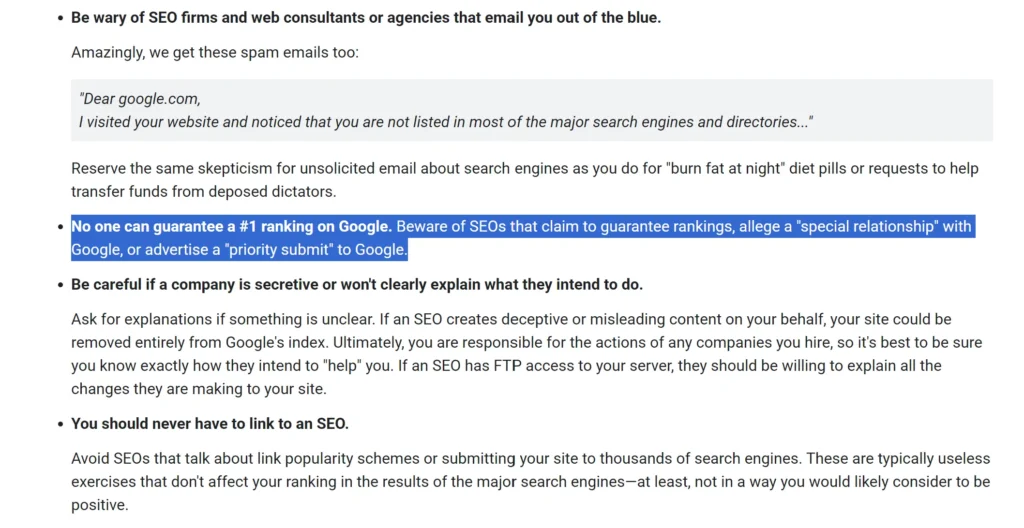
Aggressive promises become a serious concern when they cannot be supported by a clear strategy or realistic explanation of risk.Such promises can shift attention toward quick, visible results rather than sustainable business value.
An agency may legitimately use proprietary tools, processes or internal systems. Protecting those assets is different from refusing to explain the work being performed. The provider should still describe its transparent SEO strategy, intended activities, relevant risks and reasons for recommending each approach. “We cannot explain because it is secret” is not an adequate response when the client is being asked to approve work that could affect its website.
Unclear Deliverables, Reporting or Ownership
Look more closely when a proposal or sales process includes:
- Vague terms such as “ongoing optimization” without defining the work
- No agreed reporting schedule or record of completed activities
- Reports limited to rankings or traffic without relevant business context
- Unclear responsibility for implementation, approvals or delays
- Essential analytics or search accounts controlled entirely by the agency
- No process for transferring data, content, accounts or completed work during offboarding
- Pressure to sign before the scope, responsibilities or cancellation terms are understood
Raise each concern directly with the agency. A clear, consistent and documented response may resolve the issue, particularly when the original proposal was simply incomplete. An evasive or contradictory answer increases uncertainty and should be considered alongside the other evidence gathered during the selection process.
How to Know Whether Your SEO Agency Is Performing
To measure whether your SEO agency is performing well, review progress against the agreed baseline, roadmap, responsibilities and business goals, not keyword positions alone. A useful performance review should distinguish between completed work, early signs of improvement and the commercial outcomes the engagement is intended to support.
Track Progress Beyond Keyword Positions
SEO performance can be assessed across three connected levels, supported by a separate accountability check:
- Implementation progress: Whether agreed technical, content, tracking and authority-related work has been completed or advanced.
- Leading indicators: Whether crawl accessibility, indexation, non-branded visibility, impressions and priority-page performance are moving in the intended direction.
- Business outcomes: Whether organic search is contributing to qualified leads, conversions or revenue.
Leading indicators can show that the strategy is gaining traction before commercial outcomes become visible. However, they do not guarantee that those outcomes will follow. They should be interpreted alongside implementation quality, market conditions and the website’s ability to convert relevant visitors.
| Review area | Examples | What it helps determine |
| Implementation progress | Technical fixes, content published, tracking improvements and resolved blockers | Whether agreed work is being completed |
| Leading indicators | Indexation, non-branded impressions, relevant visibility and engagement with priority pages | Whether search presence is moving in the intended direction |
| Business outcomes | Qualified leads, organic conversions and revenue influenced by organic search | Whether SEO is contributing to commercial goals |
| Accountability | Clear explanations, documented work, identified problems and corrective actions | Whether the agency is managing performance transparently |
Not every metric needs to increase during every reporting period. Results should be interpreted against the website’s baseline, competitive environment, implementation pace and agreed strategy. The appropriate review period will therefore depend on the site, market and scope rather than a universal SEO timeline.
The agency should explain material changes, unresolved blockers, actions that did not produce the intended effect and any resulting adjustment to priorities. Completed activity alone is not sufficient if it consistently fails to create meaningful progress. At the same time, conversions and revenue can also be affected by seasonality, pricing, website experience, sales processes and other marketing channels, so changes should not automatically be attributed entirely to SEO.
If agreed work remains incomplete, reporting is unclear or meaningful progress is consistently absent, request a documented explanation and corrective plan. The response should identify the cause, assign responsibilities, define the next actions and establish how the revised approach will be reviewed.
Choose the Agency That Can Explain the Work
The final decision should favor an agency that can explain what it recommends, why each priority matters and who will complete the work. It should also clarify how progress will be measured, what your business will own and how the agency will respond when results or circumstances differ from initial expectations.
Learning how to choose a reliable SEO agency ultimately means replacing assumptions with relevant evidence, documented responsibilities and clear expectations. The 100-point agency scorecard can make the comparison more consistent, but the total should not replace final verification or override unresolved non-negotiable concerns.
The lowest price, biggest name or most persuasive sales presentation should not determine the decision by itself. The most suitable partner will demonstrate business alignment, a clear strategy, accountable delivery and transparent communication while remaining realistic about what SEO can and cannot achieve.
If you have started evaluating potential partners and would like to discuss your website, goals and what an appropriate SEO scope could include, book a free SEO consultation with Solve SEO Agency.
Frequently Asked Questions
There is no universal deadline for an SEO agency to show progress. The appropriate review period depends on the website’s baseline, market competition, the scale of existing problems, implementation speed, available internal resources and the agreed scope. Early progress may appear through completed implementation and improving leading indicators before qualified leads or revenue change. The agency should establish review points, expected milestones and the conditions that would trigger a strategy reassessment.
Yes, an SEO agency can create forecasts, projections or scenario ranges using existing performance, search demand, competition and planned work. However, forecasts depend on documented assumptions and are not guarantees. Exact rankings, traffic, leads or revenue cannot be promised reliably because results are also affected by competitors, search-engine changes, implementation, website experience and market conditions. A credible forecast explains its inputs, assumptions and limitations; an unsupported promise presents an outcome without showing how it was calculated.
Hire an SEO agency when the required work exceeds the time, knowledge or capacity available internally. DIY SEO may be reasonable for a small, straightforward website when the owner has sufficient knowledge, time and a limited budget. An agency may be more appropriate when technical problems require specialist support, content and authority building need coordination, a redesign or migration is planned, organic search could materially affect revenue or lead generation, or the business needs accountable implementation and measurement. Not every business requires an agency.
Hiring an SEO company can be worthwhile when organic search supports commercially valuable goals and the business can support the implementation required. Its potential value depends on relevant search demand, customer value, profit margins, competitive opportunity, website condition and the required investment. SEO may not be the immediate priority when search demand is weak, implementation resources are unavailable or another channel presents a clearer near-term opportunity. The decision should reflect expected business value rather than traffic potential alone.